
The Social Reset Mechanism
Abstract → The Cucuteni–Trypillia cultural complex (c. 5400–2750 BCE) presents a significant challenge to the traditional Eurocentric narrative of civilizational development. While typical trajectories toward complexity involve permanent architecture and the consolidation of hierarchy, the Cucuteni–Trypillia world thrived through a „reset algorithm”—a system of ritualized destruction and social leveling that prevented the ossification of power. This article examines the „Burned House Phenomenon” not as a byproduct of conflict, but as a deliberate social technology designed to maintain a long-term „peace framework” across the forest-steppe of Eastern Europe. In strict analytical terms, we do not have evidence for a “peace utopia,” but we do have sufficient data to speak about a non-classical social system with stabilizing mechanisms different from those of early states / societies / civilizations.
1. The Paradox of Non-Fortified Urbanism → The emergence of Trypillia „megasites” (such as Nebelivka and Taljanky) represents one of the earliest experiments in massive-scale human aggregation. These settlements, often exceeding 300 hectares with populations estimated in the tens of thousands, lacked the quintessential markers of Bronze Age urbanism: defensive walls, citadels, and palatial complexes. The absence of militarized architecture suggests that security was not maintained through physical exclusion (walls), but through a robust internal social contract. In this „peace framework,” the lack of fortification implies a low-conflict environment sustained by shared symbolic systems and high levels of communal trust, rather than coercive governance.
2. The Burned House Phenomenon → A Social Technology The most distinctive archaeological signature of this culture is the systematic, intentional burning of dwellings. For decades, researchers debated whether these fires were the result of accidental accidents or enemy raids. However, the patterned nature of the destruction—synchronized across settlements and occurring at intervals of 60 to 80 years—suggests a ritualized closure of domestic life. From an anthropological perspective, this acts as a Social Resetting Mechanism. By incinerating the domestic structure and its associated material wealth, the community enacted a „system restore.” This prevented the accumulation of „house-based” prestige and halted the emergence of landed dynasties. The fire served as a leveling agent, ensuring that each generation began from a relatively equal material baseline.
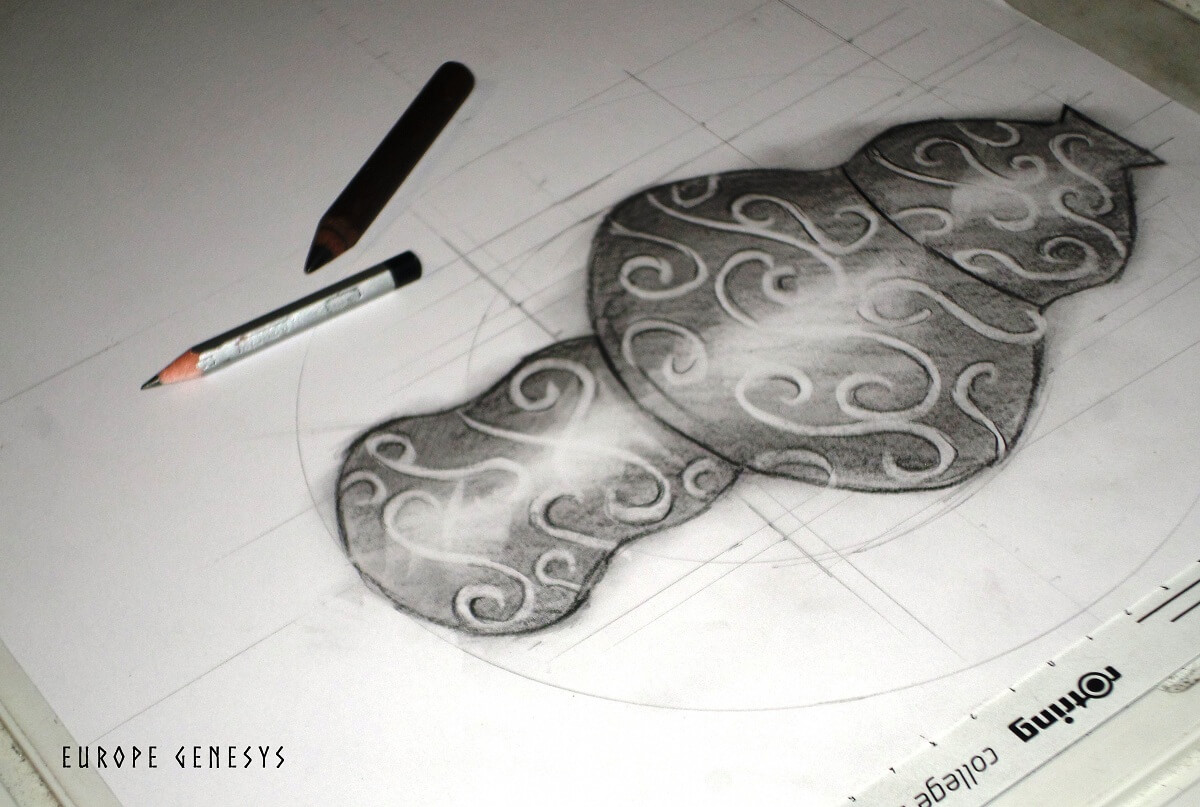
3. Leveling Mechanisms and the „Peace Framework” → The Cucuteni–Trypillia world utilized several „leveling mechanisms” to suppress the rise of a permanent elite. Spatial Parity: house layouts and sizes remain remarkably consistent across megasite concentric rings, suggesting a rejection of architectural hierarchy. Distributive Craft Specialization: while pottery production was highly advanced, it was widely distributed rather than centralized under a ruling authority. Symbolic Homogeneity: the „Ceramic Cosmology”—defined by intricate spirals and anthropomorphic figurines—provided a shared identity that transcended individual household wealth. These mechanisms suggest that the „peace” of the Cucuteni–Trypillia was not a passive state, but an active, engineered outcome of their social algorithm. By periodically destroying the material markers of status, they mitigated the primary drivers of internal social friction and external warfare.
4. Cyclical Urbanism vs. Linear Accumulation → Unlike the Mesopotamian model of „accumulation and expansion,” the Cucuteni–Trypillia followed a model of cyclical urbanism. They viewed the settlement not as a permanent monument, but as a living organism with a finite lifespan. When the „reset” was triggered—whether by soil depletion, population density, or ritual timing—the community relocated and rebuilt. This rejection of permanence allowed them to maintain a decentralized, egalitarian structure (distributed governance with temporary coordination structures, not absence of hierarchy altogether) for over two millennia, proving that large-scale complexity does not necessitate the „state” in its coercive, hierarchical form.
Conclusion → The Universal Reset Pattern
The Cucuteni–Trypillia experiment reminds us that the trajectory of human civilization is not set in stone. Their ability to manage tens of thousands of people through ritualized destruction and social leveling offers a profound look at alternative modes of governance.
This concept of the „reset”—the intentional breaking of a system to allow for its renewal—is a theme that resonates far beyond the Neolithic forest-steppe. It echoes through the deep-time myths of humanity, where catastrophic purges are often framed as necessary corrections to a corrupted social or spiritual order.
11000 BC → WATER RESET
To explore how these archaeological findings intersect with the broader mythological and historical frameworks of human „reset” events, including the symbolic and structural parallels found in ancient narratives, continue reading below → The Biblical Flood: A Reset Algorithm?