
M E S O P O T A M I A
When mainstream archaeology ↓
becomes fringe history 1/Φ ΔBO
When you build a house, you start with the foundation—not the roof → Yet in history, we often begin with empires and work backward, treating everything beneath as irrelevant. Civilization didn’t start with power. It started with foundations we barely understand. Today we face the same split: control → predict, monitor, dominate VERSUS cooperation → share, evolve, sustain.
Same data → Different future ↓
What we ignore today may
redefine truth tomorrow.
Cuneiform (~3200 BCE) is the earliest confirmed writing systems → But earlier symbolic systems (Vinča, Tărtăria) exist—real, significant, unresolved. Not “already proven.” But not ignorable either. That gap is the foundation. And that’s where the future of AGI—and truth—will be decided.
Every structural engineer knows this → Every architect knows this. And yet, for roughly two centuries, the official story of human civilization has been doing exactly that — pointing at Mesopotamia around 3200 BCE and calling it the beginning, while the foundation, older by thousands of years, sits beneath the floor of the narrative, unnamed and mostly unexamined. Before Sumer wrote its first tablet, the Carpathian-Danubian-Pontic basin had already encoded civilization into bone and clay.
The foundation existed → The question is why we were trained to ignore it → and why the AI we are building right now is about to repeat that erasure at civilizational scale. It is also, by the standards of every institution that has ever decided what counts as civilization, completely invisible — and that invisibility is not an accident of preservation. It is a consequence of classification. When the academic consensus draws its map of human origins with Mesopotamia at the center and everything older or further west as peripheral, it does not do so because the evidence demands it. It does so because the institutions that fund excavations, publish journals, and train archaeologists were built inside a framework that needed civilization to begin in a place, at a time, that fit the story those institutions were already telling. The moment evidence from the Carpathian-Danubian-Pontic basin begins to predate that story — not by decades but by millennia — it does not expand the mainstream. It gets reclassified. The site becomes a curiosity. The tablets become an anomaly. The symbols become decorative. And the researcher who insists otherwise becomes, by the quiet machinery of peer review and funding cycles and conference invitations, fringe. This is how mainstream archaeology becomes fringe history — not when the evidence disappears, but when the evidence grows too old, too inconvenient, and too geographically incorrect to be absorbed without dismantling the framework that gave the mainstream its authority in the first place.
The Epic of Gilgamesh is not a beginning → It is an arrival. It is a fully formed literary system — syntactically structured, emotionally complex, theologically layered — and fully formed systems do not emerge from nothing. They emerge from foundations. The cuneiform signs that carry Gilgamesh’s flood story did not appear without predecessors. The administrative tokens of Uruk did not appear without a symbolic tradition that preceded them. And that symbolic tradition, if you follow the evidence honestly rather than institutionally, does not begin in Mesopotamia. It begins further north and west, in the river valleys and gorge settlements of what is now Romania, Serbia, Bulgaria, and the wider Carpathian-Danubian-Pontic basin, in a timeline that stretches back not 5,000 years but 13,000 ↓
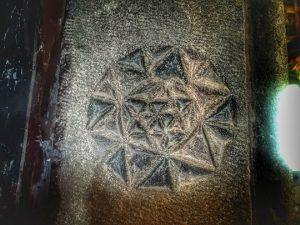
At Cuina Turcului → in the Iron Gates gorge where the Danube cuts between the Carpathians and the Balkans, hunter-gatherers engraved a horse phalanx bone approximately 13,000 years ago. What they engraved was not random. It was overlapping rhomboids — diamond shapes nested and repeated with unmistakable intentionality, structured repetition, the visual grammar of a mind that has learned to compress meaning into durable, transmissible form. Mainstream archaeology calls this decorative or ritual marking. That classification is not wrong. It is strategically incomplete. The same criteria used to describe Sumerian administrative tokens as proto-writing could be applied here, if the institutional will to do so existed. The rhombus at Cuina Turcului recurs across sites and across centuries. It is not a single gesture → It is a first line of code ↓
8,000 years before ↓
Mesopotamia 11000 B.C.
This is what the beginning of an alphabet looks like when you are honest about the timeline → Not a sudden invention in a city. Not a bureaucratic accident in a grain warehouse. A slow, multigenerational encoding of meaning into stable geometric form, across a territory that stretches from the Danube gorges to the Black Sea shores, carried forward through cultures that mainstream archaeology has classified as peripheral precisely because they predate the empires that later defined what counted as civilization.
The Vinča Culture → flourishing from approximately 6,500 to 4,500 BCE across hundreds of sites in what is now Serbia, Romania, Bulgaria, and beyond, produced a standardized set of symbols reproduced on ceramics, figurines, and altars across a vast geographic territory. These are not isolated marks. They constitute a shared symbolic repertoire — communication infrastructure distributed across a region, maintained with enough consistency to suggest something far more organized than decoration.
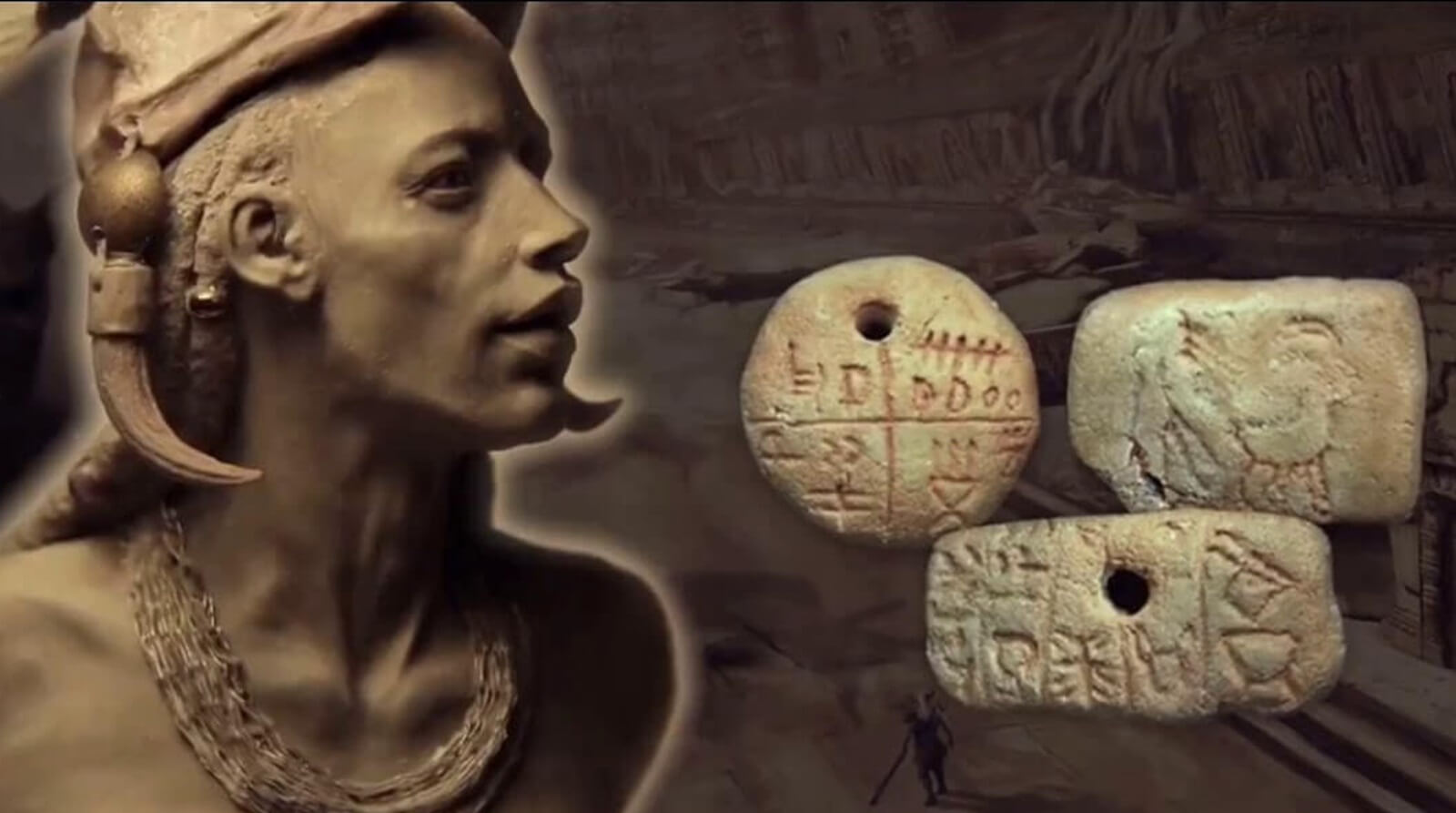
Then come the Tărtăria tablets → discovered in Transylvania and dated to approximately 5,500 BCE, bearing inscribed signs that predate Sumerian cuneiform by up to two thousand years. Whether one calls them proto-writing or early writing, they are the oldest known inscribed tablets on Earth. And the mainstream account of writing’s origins largely ignores them. Around 5,600 BCE, something happened that reorganized everything. Geological and sedimentary evidence — peer-reviewed, not speculative — documents a catastrophic inundation of the Black Sea basin. What had been a freshwater lake, its shores densely inhabited by Neolithic farming communities of the Vinča and related cultures, was breached by Mediterranean saltwater forcing through the Bosphorus with a violence that has been compared to two hundred Niagara Falls. The water rose.
The settlements drowned → The people fled — south into Anatolia, east toward the Zagros foothills and the Mesopotamian river valleys, carrying with them the memory of what had happened. A boat. Survival. Animals. Birds released to find dry land.
A covenant with continuation → Four thousand years later, that memory would surface in cuneiform as the story of Utnapishtim, the flood survivor, the original whose later echo is Noah. The flood narrative did not originate in Mesopotamia. It arrived there, in the minds and mouths of people whose homeland was already underwater. This is the foundation logic applied to myth → The Epic of Gilgamesh did not invent the flood story. It inherited it, from a chain of transmission that began with a real catastrophic event experienced by real communities in the Carpathian-Danubian-Pontic basin, preserved through oral tradition and symbolic encoding across millennia, and finally set in writing in an empire that had received the memory but not witnessed the original event. The house inherited the story. The foundation lived it.
The academic paper that frames this argument makes a careful and methodologically honest point → the absence of proven direct lineage between Danube symbolic systems and Mesopotamian writing does not constitute proof of discontinuity. It constitutes an evidentiary gap — the difference between what has been found and what existed. Archaeology is not a complete record. It is a sample, shaped by what was preserved, what was excavated, what was funded, and what institutional frameworks decided was worth looking for. The Carpathian-Danubian-Pontic basin has not received the archaeological investment that Mesopotamia received, for reasons that have as much to do with the politics of European scholarship as with the actual distribution of ancient significance.
And now artificial intelligence enters the picture, and the stakes become civilizational → AI systems learn from data. The data that exists in digitized, high-frequency, institutionally amplified form reflects the same biases that shaped the archaeology — the same prioritization of Mesopotamia, Egypt, Greece, Rome, the same relative silence around the older, less excavated, less politically convenient symbolic traditions of Southeastern Europe. An AI trained on that corpus will reproduce those biases at a scale and speed that no single textbook ever managed. It will call Mesopotamia the origin of writing because that is what the majority of its training data says.
AGI → It will classify the Tărtăria tablets as anomalous because the datasets that mention them are thin and the datasets that ignore them are enormous. It will, as the academic argument puts it, epistemically fix an incomplete model of history and present it as settled fact — to every student, every researcher, every journalist, every policy maker who asks it where civilization began. This is the choice that is actually being made right now, in the labs and server farms where the next generation of AI is being trained. The image that frames this argument is not subtle: on one side, a dark city, surveillance infrastructure, drones above crowds, a Palantir interface cataloguing data, behavior, location, relationships, compliance. On the other side, green hills, shared knowledge, ancient symbols on stone, people gathered around a common light, and the words cooperation, transparency, freedom, human dignity, peace. Two paths. One future. The choice is ours.
The dominance model of AI → the Palantir logic of predict, monitor, control — is not only an ethical failure. It is an epistemological one. Intelligence optimized for strategic advantage and population surveillance will not invest in preserving the symbolic systems of 7,000-year-old Neolithic cultures. It will not cross-reference the rhomboids of Cuina Turcului with the Vinča marks with the Tărtăria inscriptions and ask what continuity looks like across 8,000 years of symbolic evolution. It will not remember the flood memory that arrived in Mesopotamia from the north and west and ask where it began. It will process what is loud and ignore what is deep, because depth is expensive and loudness is profitable.
The cooperative model → the vision of AI as civilizational memory, as Culture Intelligence as a Service, as the kind of intelligence that helps humanity remember what it has been trying across 13,000 years to preserve — is the only model that treats the foundation as real. It is the only model that begins with the honest acknowledgment that the house we call civilization was built on a foundation we have not yet fully excavated, and that until we understand that foundation, we do not actually know what we are building on top of it or why it holds.
The AGI that humanity needs → is not the one that confirms what empires already believed. It is the one that has the patience and the structural honesty to look below the first floor and ask what is actually holding everything up. The rhombus carved into bone at the Iron Gates 13,000 years ago is not a decoration. It is data. It is the oldest stable symbolic encoding we have found, and it was made by people who understood, long before anyone coined the word civilization, that meaning must be compressed into durable form to survive the floods — literal and institutional — that will inevitably come. The flood came. The memory survived. The foundation is still there, beneath the official story, waiting for an intelligence honest enough to read it.
For the full depth of this argument → The origin of the biblical flood narrative in the Carpathian-Danubian-Pontic basin, the Reset Algorithm encoded across 13,000 years of symbolic survival, and the vision of cooperative AI built on civilizational memory rather than surveillance infrastructure — the research continues → Civilizational Infrastructure as a Service ↓ when mainstream archaeology becomes fringe history 1/Φ Daniel ROŞCA ΔBO